3 posts tagged with "automation"

View All Tags

What ILTCI Revealed About AI and Underwriting Automation in Long-Term Care | Part 2

· 5 min read
Uniblox Research Team
Discovering the future of InsurTech

In Part 1 of this series, we covered what ILTCI 2026 revealed about the state of AI adoption in long-term care insurance: the economics driving urgency, the consumer drop-off problem, selective underwriting acceleration, and the compliance frontier.

This second part goes deeper into what implementation actually looks like inside carrier organizations, where most platforms fall short, and what the carriers making real progress are doing differently.

Read Part 1 of the ILTCI key takeaways ILTCI 2026 Takeaways Part 2

Why Generic Underwriting Platforms Fail in LTC

A recurring tension at ILTCI was the gap between what underwriting automation platforms promise and what they deliver in practice.

LTC and life insurance products involve highly specific rules. Underwriting guidelines vary by carrier, product design, state regulation, and distribution channel. What qualifies as a clean case for one carrier may be declined by another. Automation systems that cannot reflect these nuances create new operational burdens rather than removing them.

Several carriers described building hundreds of condition-specific rules inside their underwriting engines and refining them continuously through outcome analysis. Technology performs well only when it is configurable enough to reflect each carrier's risk appetite and product structure. Platforms that lack this flexibility simply shift exception handling from paper processes into software.

The Data Fragmentation Problem

Automation struggles when underwriting, product, compliance, and analytics teams operate from separate systems with inconsistent data. Many carriers described situations where automation outputs were questioned internally because teams held different interpretations of the rules or risk philosophy the system was meant to encode.

Organizations making meaningful progress share three characteristics:

  • A single source of truth for underwriting rules and product configuration
  • Cross-functional alignment on system goals
  • Regular review cycles to evaluate automated decisions and refine rules

Several carriers reported holding weekly meetings to evaluate outcomes and adjust rule sets before problems compound. Operational alignment, more than technology selection, often determines whether underwriting automation programs succeed.

Automation Changes the Role of Underwriters

As routine cases move through automated workflows, underwriters spend more time on complex decisions. This shift increases the importance of several skills:

  • Complex case analysis and critical thinking
  • Data interpretation and model evaluation
  • Technology literacy
  • Clear communication with producers and applicants

One panelist described the evolving role succinctly: underwriters are becoming risk storytellers, connecting multiple data signals into a coherent decision narrative.

Another panelist noted that building trust in automated systems took nearly a year. The turning point came when underwriters were encouraged to question automated outputs and escalate concerns rather than simply accepting system recommendations.

Automation does not reduce the importance of human judgment. It concentrates it where it matters most.

Agent Enablement Is a Major Distribution Opportunity

LTC products are complex, and many advisors sell them infrequently. As a result, agent conversations with clients can vary widely in quality and accuracy. This creates downstream problems:

  • Incomplete applications
  • Misaligned expectations
  • Clients purchasing coverage without fully understanding it

Several panels highlighted agent enablement as a high-impact area for AI support. Potential applications include:

  • Structured pre-qualification conversations
  • Automated follow-up communication
  • Educational tools explaining coverage needs
  • Guided application workflows

Better agent education improves application quality and increases placement rates. It also strengthens policyholder persistency, which is strongly linked to whether clients understand why they purchased coverage.

Implementation Lessons for Carriers

Several panel discussions highlighted practical differences between large and smaller organizations implementing AI. Large carriers benefit from distributing experimentation across departments so domain experts can identify where automation helps most. They also need governance frameworks in place before scaling adoption.

For smaller organizations:

  • Start with one clearly defined use case
  • Demonstrate measurable value before expanding
  • Build team familiarity with tools before broadening scope

On the question of building internally versus partnering with vendors, panelists were direct. AI capabilities are evolving quickly, and most organizations cannot maintain expertise across every domain. Partnering with teams that combine technical expertise with deep insurance knowledge can accelerate implementation significantly.

The qualification matters equally: acceleration only materializes when the partner has real domain depth, not just technical capability.

The Real Question After ILTCI

The LTC industry’s core challenges are well known:

  • Fragmented data
  • Long application cycles
  • Inconsistent advisor conversations
  • Slow underwriting decisions

What has changed is that the tools to address these problems are no longer experimental. They are already operational for a growing group of carriers. Organizations making progress share a common approach:

  • Connecting technology to clearly defined operational problems
  • Aligning teams around shared workflows
  • Treating implementation as the start of an ongoing improvement cycle

What separates them is not access to better ideas. It is access to technology built specifically for this market.

What makes LTC transformation difficult is not a shortage of ambition. The challenge is that the technology required is genuinely difficult to build for this market.

Carrier-specific rules, compliance variation across states, and distribution workflows that need to operate seamlessly together make internal development far more complex than most organizations expect.

ILTCI surfaced a wide range of discussions—from the urgency around AI adoption and rising cost pressures to shifting consumer expectations and what implementation actually looks like inside organizations trying to operationalize these ideas.

Taken together, the conversations at ILTCI point to a clear shift. The next phase of underwriting modernization won’t be defined by new ideas or new technologies. It will be defined by how effectively carriers translate those ideas into working operational systems.

And for many organizations in the room, that work is already underway.

What ILTCI Revealed About AI and Underwriting Automation in LTC | Part 1

· 6 min read
Uniblox Research Team
Discovering the future of InsurTech

The 2026 ILTCI Conference made one thing clear: AI is no longer a theoretical conversation in long-term care insurance. The discussion has shifted from whether AI will reshape underwriting and distribution to why so many organizations are still waiting to act.

More than 1,050 actuaries, underwriters, product leaders, compliance teams, and distributors attended the event. Across sessions and panel discussions, the same operational challenges surfaced repeatedly: long application cycles, fragmented data, inconsistent advisor conversations, and underwriting decisions that take months instead of weeks.

The technology to address many of these issues already exists. The real question is how carriers apply it inside the regulatory and operational realities of the LTC market.

ILTCI 2026 Takeaways Part 1

AI Is Reshaping LTC Underwriting Economics

Carriers using AI effectively are already operating on a different cost curve.

Tasks that previously cost $50 to $75 to process can now be completed for a fraction of that amount. This isn't just an efficiency gain. It changes the economics of underwriting operations entirely. Panel discussions across the conference emphasized three realities:

  • Delayed adoption carries compounding consequences as the gap between early adopters and slower organizations widens
  • In regulated markets like LTC and life insurance, AI will support underwriting decisions rather than replace them. Regulators are unlikely to approve fully automated black-box decision models
  • The most valuable applications of AI exist within the regulatory framework, including accelerating product development, supporting compliance work, and improving target population analysis

For most carriers, the challenge isn't deciding whether to adopt AI. It's identifying the workflows where automation genuinely creates value.

Why LTC Buyers Drop Off Before They Apply

One of the most practical discussions at ILTCI came from a panelist who described how their team studied the LTC buying journey.

Initially, they assumed improved morbidity modeling would drive conversions by making risk feel more personal. That proved only partially correct. When consumers were asked what would motivate them to apply, the answers were consistent:

  • Whether they actually needed coverage
  • How LTC insurance compares to self-funding care
  • Their likelihood of qualifying
  • A faster path from interest to a coverage decision

These insights led to the development of a quote-to-coverage workflow that compares product permutations across carriers, estimates likely underwriting outcomes, and pre-fills portions of the application using previously captured information.

The underlying insight is simple: consumers now expect near-instant answers when evaluating financial products. LTC is no longer exempt from that expectation. The gap isn't in consumer willingness to engage. It's in whether carriers have the infrastructure to meet them where they are.

Most don't. Pre-screening, underwriting logic, and application workflows typically sit in separate systems, creating handoff points where applicants drop off and momentum stalls. Closing that gap is what platforms like Uniblox are built to do — connecting those layers into a single guided enrollment journey so the path from interest to decision is continuous, not fragmented. Faster decisions don't just improve the applicant experience. They directly affect placement rates and revenue.

Selective Automation in Underwriting

Across underwriting sessions, one theme appeared repeatedly: automation works best when applied selectively.

Carriers seeing the most success are not trying to automate every case. Instead, they focus on accelerating straightforward applications while routing complex ones to human underwriters.

Several data sources are enabling this model today:

  • Prescription history data to guide requirement decisions
  • Claims data that reveals patterns beyond the application itself
  • Electronic health records, expected to reach adoption levels above 80% within five years
  • Rules engines that route cases by risk profile, moving clean cases through straight-through processing while escalating complex risks for review

One carrier shared a clear example of the impact: reducing average decision time from 45 days to 27 days produced measurable improvement in placement rates. When underwriting decisions arrive within weeks instead of months, applicants stay engaged and advisors maintain momentum.

What doesn't work is applying acceleration universally. Cognitive assessments, unstable conditions, and incomplete medical histories still require traditional underwriting judgment. The carriers building durable automation systems focus on routing logic rather than blanket speed mandates.

The science of underwriting involves data aggregation, rules-based routing, and requirement targeting. That is where automation earns its place. The art of underwriting, the judgment calls that come from experience and clinical context, still belongs with the underwriter.

LTC Application Length Is a Conversion Problem

Long applications are often treated as an unavoidable feature of LTC insurance. While the products are complex, much of the application burden comes from redundant data collection. When information captured during pre-screening is carried forward into the application process, carriers can:

  • Pre-fill sections using previously collected data
  • Skip questions already answered through external sources
  • Reduce perceived application length
  • Surface underwriting requirements earlier in the process

These changes improve completion rates and lead to cleaner submissions. Agents submit more accurate applications, underwriting teams spend less time resolving missing information, and applicants are less likely to abandon the process midway through.

Compliance Questions Still Evolving

Two areas of emerging data use generated significant discussion at the conference, and neither has a settled regulatory answer.

On genetic testing: while carriers generally do not request genetic test results directly, those results sometimes appear in medical records. Regulatory treatment varies by state, leaving carriers to navigate inconsistent guidance in real time without a consistent framework to rely on.

On behavioral signals used for fraud detection, including voice recognition or lifestyle indicators derived from digital activity: some regulators have already raised concerns about bias, transparency, and governance. The gap between what technology can analyze and what regulation allows remains significant.

Panelists consistently advised carriers to establish governance frameworks early, including bias testing and clear documentation of model design decisions. The decisions being made now will face scrutiny as regulatory frameworks catch up.

ILTCI 2026 reinforced an important point: the next advantage in LTC will not come from adopting AI broadly for the sake of AI adoption. It will come from applying automation precisely, in the workflows where speed, continuity, and underwriting focus matter most.

The winners in this market are unlikely to be the organizations that try to automate everything. They will be the ones that remove friction intelligently, connect fragmented steps across the journey, and give underwriters better tools to focus on judgment where it matters most.


Team_Uniblox_at_ILTCI_1

This is Part 1 of a two-part series on key takeaways from ILTCI 2026. Part 2 covers the operational realities of implementation: why most platforms fall short on carrier-specific configuration, the silent shop problem, the evolving underwriter role, and what agent enablement actually looks like in practice. Stay tuned!

LIMRA Workplace Benefits 2025 Recap - Pathway to Growth

· 4 min read
Uniblox Research Team
Discovering the future of InsurTech

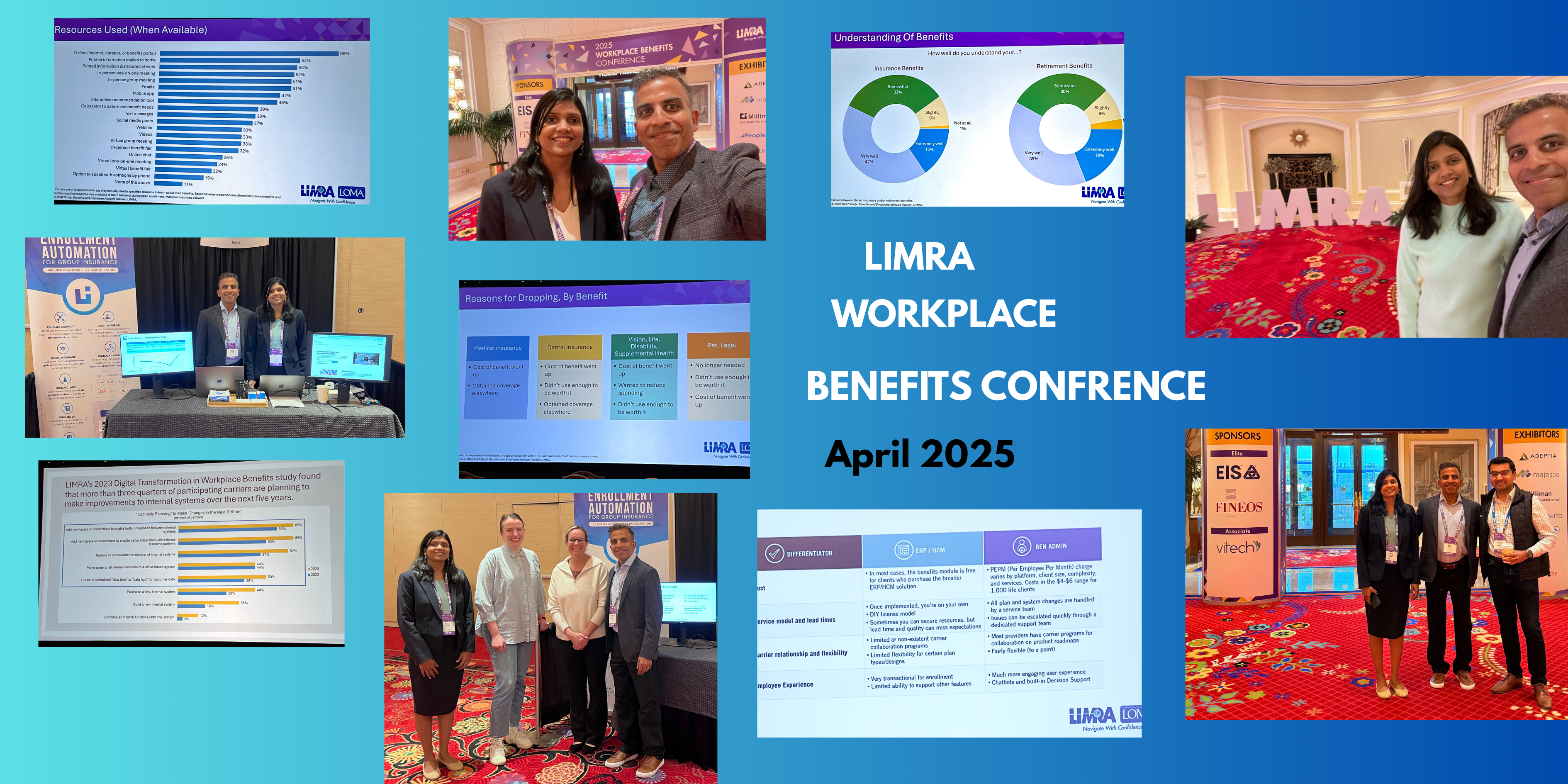
Last week, the Uniblox team had the privilege of attending the LIMRA Workplace Benefits Conference, one of the industry’s premier gatherings of insurers, brokers, benefits administrators, and technology innovators. Held in Boston, this year’s event centered around an essential theme: “Pathways to Growth.”

And growth—of systems, strategies, and relationships—was exactly what the industry showed up to explore.

From powerful keynotes to hallway conversations, one message echoed throughout the conference: technology isn’t optional anymore—it’s strategic.


👥 A Strong Presence on the Floor

Uniblox had a booth at the heart of the exhibit hall, where we connected with dozens of carriers, brokers, and partners throughout the event. From spontaneous demos to deep-dive conversations, our space became a hub for discussions around AI, integrations, automation, and solving real-world workflow challenges. The energy was palpable—and we were proud to showcase how our platform is simplifying the journey from census to enrollment.

LIMRA_Workplace_Benefits_2025


🧩 The Systems Are Slick—But Are They Connected?

One of the most resonant insights came from a panel featuring broker feedback. While today’s platforms appear “slick on the surface,” they often falter when asked to go beyond the basics. System differences and lack of connectivity still pose fundamental challenges: from unclear system-of-record issues to fragmented data and non-scalable workflows.

We’ve long believed this, and LIMRA reinforced it: premium experiences require tight integration and operational harmony across ecosystems—not just flashy UIs. That’s why Uniblox focuses on building composable, API-driven platforms with embedded AI that parse and normalize data across hundreds of formats, enabling clean, actionable handoffs between quoting, enrollment, and billing systems.


📄 “Journey of a Census File” — Our Demo Story

We had the unique opportunity to present to the LIMRA Workplace Benefits Committee, where we walked through the real-world challenges of handling census data in group insurance. We shared what we call the “Journey of a Census File”—from messy emails and zipped folders to fully structured and validated input.

To solve that, we’ve built agentic AI models trained on thousands of real-world files that automatically extract, validate, deduplicate, and structure census data—turning it into a reliable foundation for underwriting and enrollment.

But the journey doesn’t stop there.

Uniblox enables carriers to kick off enrollment during the pre-enrollment phase, powered by AI that predicts and fills in gaps in the census, applies business rules, and integrates plan designs. During the enrollment period, our platform ensures clean, deduplicated data is consistently synced across HRIS, BenAdmin, and carrier systems. After enrollment closes, we clean up edge cases, reconcile records, to avoid delays or billing mismatches.

It’s a continuous loop—not just parsing a file, but orchestrating the entire lifecycle of enrollment data so that underwriters, administrators, and implementation teams stay aligned and in control.


📈 From Quote to Enrollment—And Beyond

What set our conversations apart was the ability to demonstrate how Uniblox closes the loop between quoting, plan design, enrollment, and post-sale data exchange.

Whether we were showcasing:

  • Our native Workday and ADP integrations
  • Real-time enrollment reporting
  • Built-in EDI with major carriers

…carriers and brokers alike saw what we mean by “eCommerce for insurance products”: seamless workflows, instant feedback loops, and zero handoffs lost in translation.


💬 Conversations That Matter

We were thrilled to reconnect with old partners, meet enthusiastic prospects, and hear from leaders who’ve been in the trenches of this space for decades. Some takeaways that stuck with us:

  • “The future of benefits isn’t one-size-fits-all.” Personalization and flexibility will define the next decade.
  • “Meeting customers where they are” means embracing complexity and solving it elegantly.
  • “Distribution innovation must be tech-led, but human-centered.” Tools must empower—not replace—the professionals driving this space forward.

🚀 What’s Next?

The LIMRA Workplace Benefits Conference reminded us that building the right pathways to growth means more than scaling systems—it means solving for the real-world complexities of data, distribution, and decision-making.

As we continue collaborating with carriers and brokers, our goal remains simple: remove the friction from the quote-to-enroll process, and empower every stakeholder with better tools, cleaner data, and more control.

We’re grateful to LIMRA and all the incredible professionals we met in Boston. We left inspired, energized, and more certain than ever that the future of insurance distribution is already here—it’s just not evenly distributed yet.

Together, we’re making seamless, intelligent distribution the new standard.