Events
From LIMRA ETSS 2026: How Insurance Infrastructure Is Being Rebuilt for Real-Time Execution
From LIMRA ETSS 2026: How Insurance Infrastructure Is Being Rebuilt for Real-Time Execution
The gap between capability and execution in insurance is often framed as an experience challenge. In practice, it is rooted in how underlying systems are designed and operate.
At LIMRA ETSS 2026, that gap was visible across nearly every session, in how carriers and platforms talk about API adoption, in how implementation timelines are still measured in months rather than days, and in how participation is reported without a reliable definition of who is actually eligible.
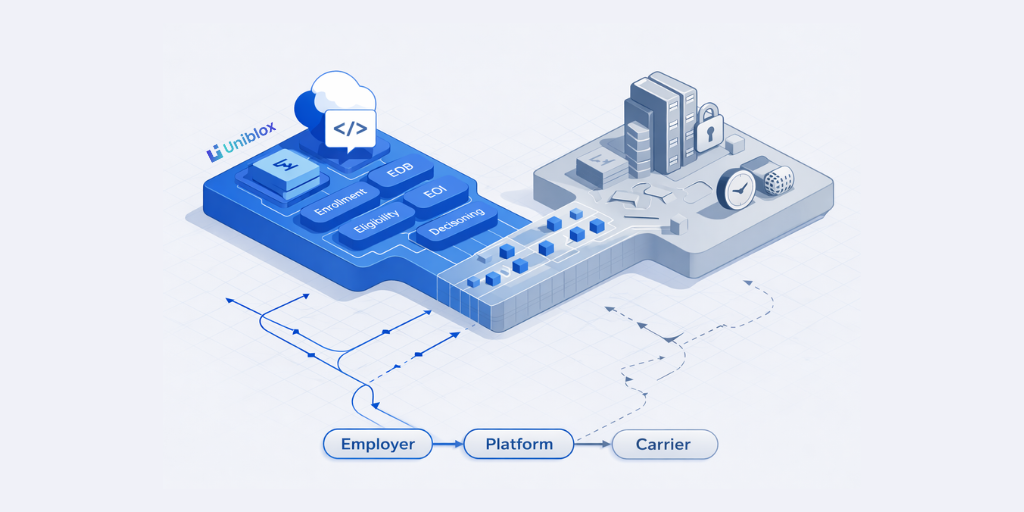
The conversations pointed to a consistent pattern: organizations are investing in faster integrations and better user experiences while continuing to operate on architectures designed for batch processing, sequential workflows, and periodic updates.
What emerged across sessions on APIs, EDI transformation, GA operations, and distribution strategy was not a set of isolated pain points, but a structural picture of where the benefits ecosystem breaks and what it would take to operate differently.
Enabling Continuous Enrollment Across the Benefits Lifecycle
Enrollment has traditionally been treated as a defined event, anchored around open enrollment windows and supported by workflows designed for periodic data exchange. While that model continues to serve its purpose, it is increasingly being extended to support interactions outside those windows, including off-cycle changes and qualifying life events.
In practice, enrollment is becoming more continuous. Employees update demographic information, make plan selections, complete Evidence of Insurability (EOI) where required, and engage with benefits throughout the year. At the same time, employers and partners expect these changes to be captured, validated, and reflected across carrier and platform systems without delay.
This introduces new requirements for how enrollment workflows are designed:
- Data needs to be updated and validated in near real time, rather than processed in batches after submission
- Decision support and EOI workflows need to be embedded within the enrollment flow
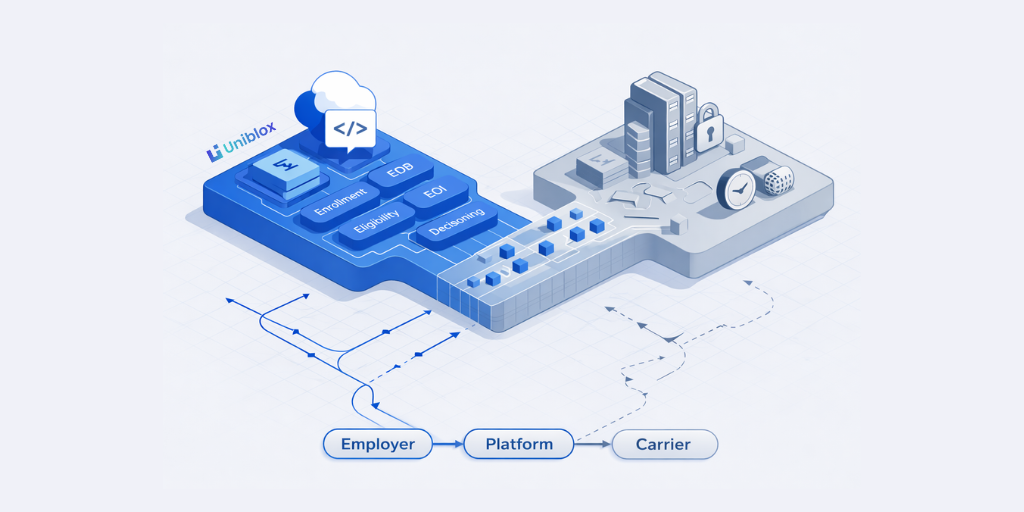
- Changes need to propagate across eligibility, carrier systems of record, and downstream administration without reconciliation delays
ETSS data put the average enrollment interaction at 17 minutes, a window that hasn't grown even as plan complexity has. Each step in that window now carries more weight. This is where the distinction between enrollment and completion becomes more visible.
Systems may capture activity, but completion depends on whether users can move through the process with enough clarity to make a decision, not just select a plan. The distinction matters because 82% of employers surveyed at ETSS said they'd switch carriers for better technology. Enrollment experience is now a retention variable, not just an HR concern.
Designing Distribution for Multi-Party, Connected Workflows
A single group implementation now involves coordination across carrier systems, broker and General Agent (GA) workflows, BenAdmin platforms, and internal operations teams, each with different data requirements, timelines, and definitions of done. What gets sold and what gets implemented are increasingly different things.
As a result, distribution is no longer constrained by individual systems, but by how effectively they operate together. In practice, this introduces a different set of execution challenges:
- Data must move consistently across carrier, broker, and BenAdmin systems without repeated transformation or manual reconciliation
- Workflow dependencies must be managed across quoting, case setup, enrollment, and eligibility
- Changes in plan configuration, census data, or eligibility rules must remain synchronized across systems
Many implementation delays are not caused by a single system limitation, but by breakdowns in coordination across systems and teams. These issues often surface as extended case setup timelines, data inconsistencies, or additional operational effort to reconcile differences.
A recurring theme across ETSS sessions was how late technology partners are brought into the implementation process. Platforms are often engaged after decisions have been made after quoting, after case setup, at the point where misalignment becomes expensive rather than correctable.
The operational cost shows up as extended case setup timelines, data reconciliation work, and enrollment delays that no integration can retroactively fix.
Building Infrastructure for Real-Time Data Flow and Execution
As enrollment and distribution workflows become more interconnected, infrastructure limitations begin to surface in how data moves and is processed across systems. Delays in validation create downstream dependencies, error resolution often requires reprocessing entire datasets, and visibility is limited while data moves across systems.
These challenges are not isolated to specific integrations, but emerge from how workflows depend on sequential data handling.
-
A case study presented at ETSS illustrated what this looks like in practice: a large group implementation of over 21,000 records, run over the Thanksgiving period, completed in eight days total, with only two to three days of actual work effort. Of the records processed, fewer than 20 required correction. The rest cleared in under an hour.
-
Data processing is moving from full-file validation to transaction-level processing. Individual records can be validated and acted on without waiting for an entire dataset to be clean.
This shift is driving adoption of API-driven architectures, where data exchange becomes continuous and workflows move toward event-driven execution. However, adoption depends on upfront discovery, alignment across product, operations, and engineering teams, and sustained ownership across implementations.
Adoption remains uneven, not because APIs are technically unavailable, but because the shift requires operational and behavioral change that technology alone can't drive.
Panelists at LIMRA ETSS were direct about this: the biggest blocker to API adoption isn't funding or architecture, it's the lack of upfront alignment across product, operations, and engineering. EDI has decades of process familiarity behind it. Replacing the format without rebuilding the workflow produces faster failures, not faster implementations.
Supporting this model requires rethinking how workflows are structured across enrollment, eligibility, and downstream systems.
Connecting Decisioning and Measurement Across the Insurance Lifecycle
Decisioning in insurance has traditionally operated outside the core enrollment flow. Underwriting and Evidence of Insurability (EOI) processes are often triggered after submission, introducing additional steps, follow-ups, and delays before outcomes are finalized.
This model is increasingly shifting toward in-flow execution. EOI workflows are being integrated into enrollment journeys, and rules-based decisioning is applied at the point of data capture. Straightforward cases can now be processed without manual review, reducing dependency on post-enrollment workflows.
The impact of this shift is operational. When decisioning happens after submission, it creates rework across systems and extends timelines. In many cases, delays in underwriting are not driven by complexity, but by when decisions are made.
When handled in-line, workflows become more predictable and fewer dependencies need to be managed downstream.
This shift is already reflected in how organizations are approaching execution:
- EOI is increasingly completed within the enrollment flow rather than as a follow-up process
- Rules-based decisioning is used to handle a growing share of standard underwriting cases
- Decision outcomes are expected to be available in real time, rather than communicated after submission
How decisions are made directly shapes what can be measured.
Participation, for example, is often estimated because eligible lives are not consistently defined across carrier and platform systems. In many cases, organizations rely on proxies such as total enrolled or basic life coverage, which can overstate actual participation.
The measurement problem surfaced explicitly at ETSS: participation is one of the most cited success metrics in the industry, yet eligible lives are still hard to define consistently across carrier and platform systems.
Many organizations fall back on total sold lives or basic life enrollment as a proxy for eligibility, which can systematically overstate participation.
When reported participation is systematically overstated, it doesn't stay an administrative problem. It flows into product pricing, persistency modeling, and how carriers assess the performance of distribution partnerships.
What LIMRA ETSS 2026 Actually Signaled
LIMRA ETSS 2026 didn't surface new problems. It surfaced how far the same problems have traveled without resolution. The structural shift underway is real: enrollment is becoming continuous, distribution is becoming multi-party, and decisioning is moving closer to the point of data capture.
But the organizations that will actually operate differently are the ones rebuilding the workflows underneath:
- Not just adding APIs on top of batch architectures
- Not just reporting participation without defining eligibility
- Not just involving technology partners after the sales motion is already closed
Infrastructure isn't the story. It's the condition for every other story working.