Integrations
Build In-House or Buy? Here's What Voluntary Benefits Integration Really Costs
Workplace life insurance new premium totaled $4.4 billion in 2025. According to LIMRA. Meanwhile, Eastbridge Consulting Group forecasts, that voluntary benefit sales could reach $10.5 billion to more than $12 billion by 2028. Employers are adding products, and employees are enrolling at higher rates across demographic groups. That growth makes enrollment readiness more consequential: the platforms an employer already uses can shape which carriers and brokers make the shortlist.
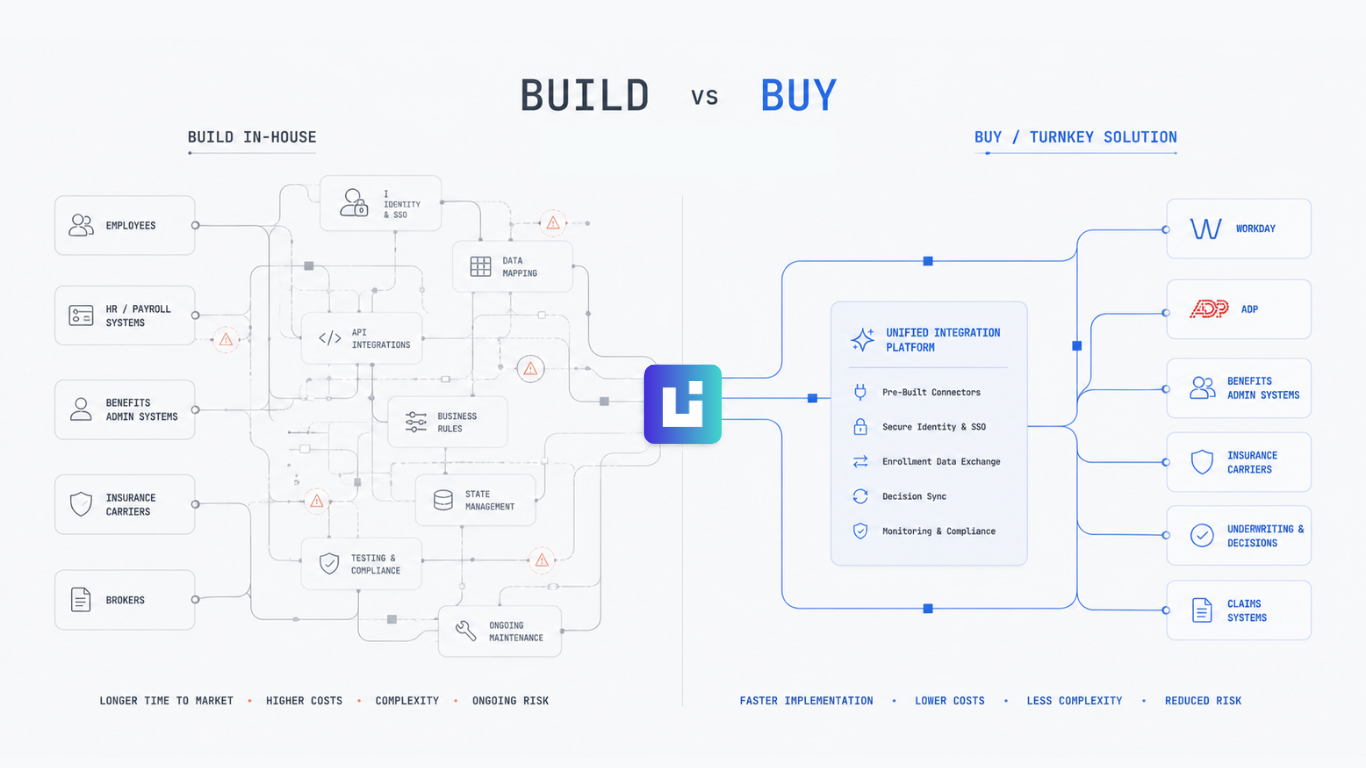
And somewhere inside every carrier and broker's growth plan, the same question keeps surfacing: do we build our own BenAdmin integration infrastructure, or do we buy it? Most teams default to build. It feels like the right call: you own the code, you control the roadmap, you avoid vendor dependency. But that instinct tends to form before anyone has done a full accounting of what building actually requires.
Key takeaways:
-
Enrollment integration is now a commercial-readiness decision as well as a technology decision.
-
A new platform integration can require roadmap access, shared specifications, planning, development, testing, and ongoing maintenance, not simply an SSO connection.
-
Roadmap access and project planning can add months, or longer, depending on the source platform, products, employer configuration, and use cases.
-
Uniblox provides production bi-directional support for ADP, Workday, PlanSource, Businessolver, bswift, Selerix while Empyrean is supported as Forward SSO launch points.
-
Standards, platform services, and plan designs change. A turnkey integration model can absorb that recurring maintenance.
Why This Is a Revenue Decision, Not a Technology One
The conversation usually starts with a deal, not a technology review.
An employer group running Workday, ADP Workforce Now, Businessolver, bswift, Empyrean, PlanSource, or Selerix may ask early whether a carrier supports the enrollment experience required for that platform. For the employer, the question is practical: can employees move into the carrier workflow with the right context, and can the necessary information move reliably between systems?
LIMRA has emphasized that carriers need technology that integrates easily with employer platforms. Workday alone serves more than 60% of the Fortune 500, underscoring why these environments matter in enterprise sales conversations.
When the answer is a file feed or a bespoke IT engagement, the employer may need to accept more manual process, a longer implementation, or both. That is why integration belongs in the growth discussion: it affects how quickly a carrier can support an opportunity, not just how its systems are designed.
What "Building It In-House" Actually Involves
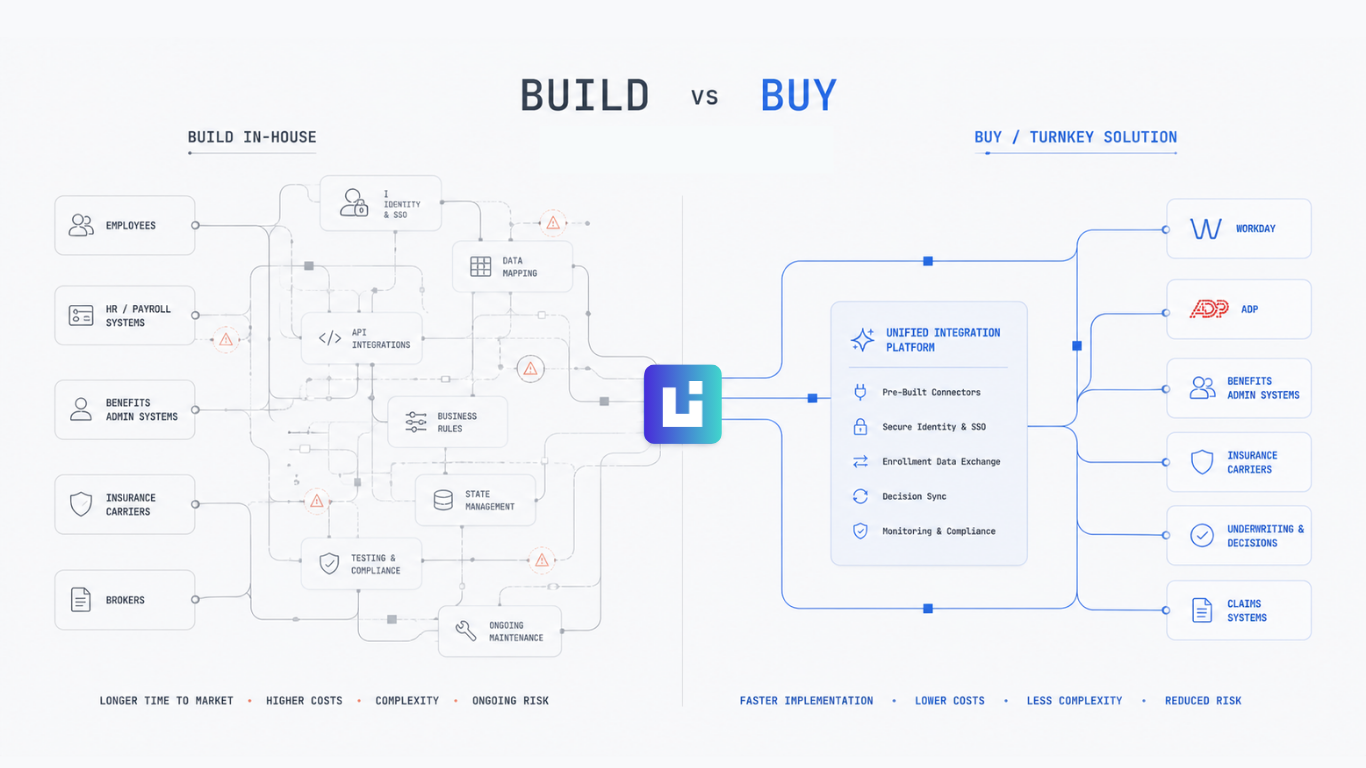
An integration is more than a launch link. It may require identity matching, enrollment-state management, employee and dependent workflows, data mapping, underwriting-decision exchange, exception handling, reporting, testing, and tenant-specific configuration.
The technical design also differs by source platform:
-
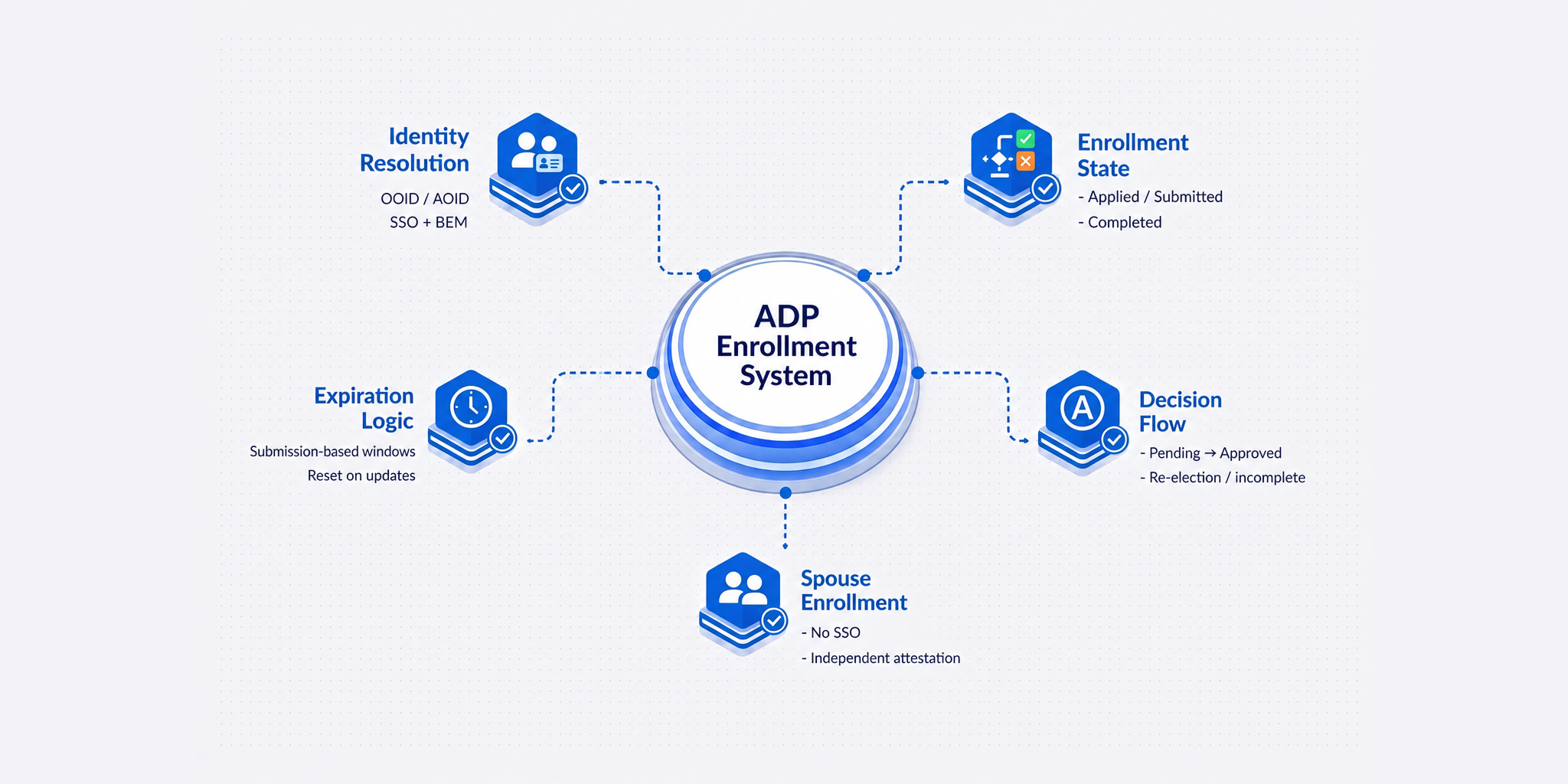
ADP: identity and enrollment-lifecycle requirements must be mapped to the carrier workflow.
-
Workday: the solution may combine RaaS data retrieval, SSO or an embedded launch, and Workday processing requirements.
-
Businessolver and bswift: the experience can involve forward launch, enrollment context, and group-specific data-delivery or reporting arrangements.
-
Empyrean, PlanSource, and Selerix: each has its own launch, configuration, and reporting requirements; a design that works for one should not be assumed to work for another.
The team must also understand the relevant data-exchange and security standards. LIMRA's LDEx program includes standards such as Benefits Enrollment Management (BEM), Benefits Configuration Management (BCM), and Evidence of Insurability Status & Decision (EOIS). LIMRA lists BEM 2.0, BCM 1.0, and EOIS 1.1 among its current releases. LIMRA also lists Uniblox among the organizations that have adopted LDEx standards, alongside ADP, Workday, Businessolver, bswift, PlanSource, and Selerix.
LIMRA ETSS 2026 coverage highlighted that communication and information processing account for roughly 64% to 68% of insurance operations time. That context matters: every new one-off integration adds another system relationship to build, test, document, and maintain.
The hidden complexity of BenAdmin enrollment integrations
The difficult work often appears after the happy-path demo. Real enrollment flows introduce edge cases: an employee record may be incomplete, a dependent election may require separate handling, an effective date may change, or an underwriting decision may need correction and resubmission.
| Platform | Implementation consideration to validate before launch |
|---|---|
| ADP | OOID and AOID identifiers must resolve correctly. Employee, spouse, and enrollment-state workflows need to be mapped and tested against the carrier flow. |
| Workday | RaaS and app Meta data, employee and spouse records, event categories, and effective-date logic need tenant-specific validation. |
| Businessolver | Field semantics require testing. A field can transmit successfully while still needing validation that its value is applied to the intended benefits record. |
| bswift | Payload packaging and reporting delivery can vary by group, including EOIS-style payloads, FTP reports, or email. |
| PlanSource | A combined SAML launch payload may need to support distinct employee and spouse application paths. Multi-policy requirements should be confirmed during scoping. |
| Empyrean | Forward SSO can support launch; client-specific configuration and any subsequent workflow requirements should be confirmed during implementation. |
| Selerix | SSO and reporting configuration are separate implementation workstreams that need to be planned for the specific tenant. |
Building only the initial launch or outbound feed does not resolve those downstream requirements. A complete implementation needs a tested operating model for the full enrollment lifecycle.
Why scaling across BenAdmin platforms gets expensive
Each additional platform adds its own specifications, release cadence, configuration choices, and testing requirements. The 2023 Ideon-LIMRA Employee Benefits API Maturity Report found that 84% of carriers were still nascent, developing, or maturing their API capabilities, while 92% said APIs were used for few or none of their external transactions. These figures illustrate how much work remains across the industry.
Engineering is not always the first bottleneck. Where a platform requires a roadmap or partner-intake process, a carrier or broker may need to complete several steps before development begins:
-
Secure a roadmap or intake slot. Depending on the platform and demand, this can add substantial lead time.
-
Receive and review specifications. The source-platform team and the carrier's IT team need a shared understanding of the integration, data, and delivery expectations.
-
Turn the requirements into a project plan. Product scope, use cases, security, testing, and employer configuration can drive a multi-month planning and delivery effort.
-
Revisit the process when the scope changes. A new product, product evolution, refiling exercise, special plan design, or changed platform requirement can require new prioritization, specifications, and testing.
Standards and source platforms evolve on their own schedules. Changes to LDEx BEM, BCM, or EOIS specifications, or to a platform's services and configuration rules, can create an IT-prioritization exercise and staged rollout. The burden does not end at launch.
What a turnkey voluntary benefits integration looks like in practice
A turnkey model gives carriers and brokers a single operating layer for the platforms that matter to their distribution strategy, rather than requiring a separate build program for every source platform.
With Uniblox, ADP integration , Workday integration, Businessolver, and bswift integration are supported through production bi-directional integrations. That means the integration is designed to support both the enrollment journey into the carrier workflow and the supported exchange of information back to the source platform. Empyrean, PlanSource, and Selerix are active Forward SSO launch points, with capabilities aligned to each platform's current integration model and expanding as those integrations mature.
Workday illustrates why this distinction matters. The integration combines SAML 2.0-based SSO and RaaS-driven data retrieval with return-decision processing through Workday Web Services, specifically the Benefits Administration web service (version 43.0). Return-decision processing is monitored per tenant; implementation should confirm authorization, EOI exception handling, and operational monitoring requirements before go-live.
The value is not only the first implementation. Ongoing work, including platform service changes, standards updates, testing, and configuration evolution, can be managed through the same integration layer instead of becoming a fresh carrier engineering project every time the environment changes.
The real build vs buy decision for insurance carriers
Building in-house can make sense for a carrier with a small, stable platform footprint, a fixed set of employer groups, and deep enrollment-infrastructure expertise already in place.
For carriers and brokers pursuing multiple mid-market or enterprise opportunities, the decision is usually broader:
| Consideration | Build in-house | Buy turnkey |
|---|---|---|
| Time to first implementation | Depends on platform intake, scope, development, and testing | Uses existing integration capability where available |
| Platform coverage | Separate engineering and operational work per platform | One integration layer across supported platforms |
| Standards and version maintenance | Carrier engineering team owns the recurring work | Managed as part of the integration service |
| Change management | New products, plan designs, and platform changes may require new scope and prioritization | Integration partner manages supported change processes |
Buying is not simply a shortcut. It is a way to make integration readiness a repeatable capability while keeping the carrier's internal team focused on product, underwriting, and distribution.
Want to see how Uniblox handles enrollment integration end to end? Book a demo →