5 Key Trends Shaping the Future of Benefits and Insurance in 2026

The benefits and insurance industry is not lacking technology. Over the past decade, carriers and platforms have invested heavily in enrollment systems, integrations, and AI. Yet a persistent gap remains between what these systems enable and what is consistently delivered across enrollment experiences, implementation timelines, and measurable outcomes.
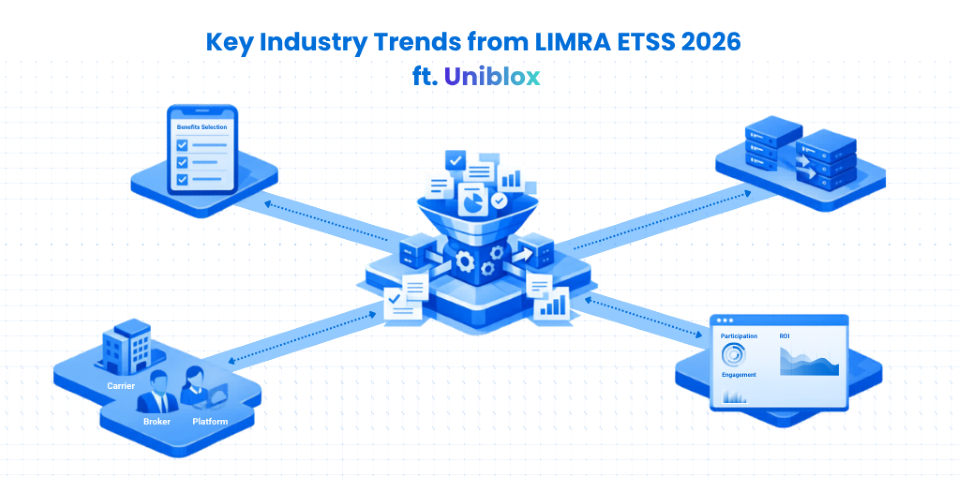
That gap has always existed but its impact is now harder to ignore. Employers are placing greater emphasis on ROI, participation, and engagement, while employees expect benefits experiences that match the speed and simplicity of consumer platforms. At the same time, organizations are under increasing pressure: benefits costs have risen between 11% and 36%, HR teams are managing more complexity with fewer resources, and a workforce spanning five generations is reshaping how benefits are evaluated and consumed.
The conversations at LIMRA ETSS 2026 reflected a clear shift. The industry is no longer asking what capabilities to build next, but how to make existing ones work together. These 5 insurance industry trends point to a broader transition, one that depends on aligning experience, infrastructure, ecosystem coordination, and measurement to deliver outcomes.
1. Enrollment Experience is All About Shaping Participation, Retention, and Carrier Choice
Expectations around benefits have shifted from administrative efficiency to consumer-grade experience. Employees no longer compare enrollment journeys to other carriers, they compare them to the speed, simplicity, and personalization of digital platforms like Amazon.
This shift is raising the bar across the lifecycle:
- Enrollment is expected to be intuitive, fast, and completed within minutes, with average enrollment windows already compressed to ~17 minutes
- Decision-making is expected to be guided and personalized, not reliant on static plan comparisons
- Engagement is expected to extend beyond enrollment into a continuous, year-round experience
The business impact is explicit. 82% of employers are willing to switch carriers for better technology and user experience, underscoring how directly experience influences buying decisions.
Delivery, however, has not kept pace:
- Employees underutilize or opt out of benefits due to lack of clarity or perceived relevance
- Decision support tools are often too complex or disconnected from the enrollment flow
- Fully digital journeys fall short without human guidance at critical decision points
This expectation is less about digitization and more about familiarity bringing the guided, low-friction experience of ecommerce into the benefits journey.
Enrollment experience is now directly shaping participation, retention, and carrier choice.
2. From Batch Processing to Real-Time: The Next Phase of Enrollment Infrastructure
The infrastructure supporting benefits enrollment was built for a batch-driven model: file exchanges, sequential workflows, and delayed validation. That model is increasingly misaligned with expectations for speed, continuity, and real-time visibility.
The shift toward real-time systems is already measurable:
- Implementation timelines that once took 2–3 months are now being compressed into days
- Large datasets can be processed in near real time, with 21,000 records handled in under an hour, and only a small subset requiring correction
- Processing is moving to transaction-level handling, allowing most records to flow without waiting for full dataset validation
The inefficiency of legacy workflows is also becoming more visible. Manual processes such as RFP evaluations can take 10 to 73 hours per case, introducing friction well before implementation begins.
What is changing is not just speed, but how systems operate:
- One-way file transfers are giving way to continuous, two-way data exchange
- Error resolution is shifting to real-time validation
- Post-enrollment blackout periods are being replaced by continuous data availability across downstream systems
This is not an incremental upgrade. It reflects a move toward systems designed for real-time operation, where responsiveness and visibility are built into the architecture. This is where carriers are rethinking how their core enrollment and underwriting infrastructure is built and connected.
3. Benefits Delivery Now Depends on Cross-Partner Coordination
The benefits experience is no longer delivered by a single system or organization. It spans carriers, brokers, platforms, and partners, each responsible for a different part of the lifecycle. The quality of that experience depends on how effectively these entities operate together.
This shift is visible in how roles are evolving:
- Platforms are influencing enrollment, engagement, and distribution outcomes, not just administration
- General Agents are expanding into technology enablement, operations, and communication support
- Carriers must align product design and data exchange with downstream systems
As coordination becomes more critical, the cost of misalignment increases. Decisions made early whether in product configuration, sales commitments, or implementation planning often surface later as delays, rework, or inconsistent experiences.
Distribution is no longer linear. It is embedded within a network of systems and relationships, where execution depends on shared accountability across stakeholders.
In this environment, value is determined less by individual capabilities and more by how effectively they connect. Increasingly, this requires platforms that can operate across systems, not just within them.
4. AI in Insurance is Shifting from Experimentation to Practical Application
AI is now embedded across the benefits ecosystem, but its role is becoming more defined. Rather than acting as a standalone transformation layer, it is being applied to improve execution within existing workflows.
Current use cases focus on areas with immediate, measurable impact:
- Streamlining communication through drafting, summarization, and response generation
- Reducing manual effort by consolidating inputs across workflows
- Moving from static reporting to recommendations and next-best actions
These applications align with where AI is most effective tasks that are repetitive, communication-heavy, and time-intensive. Areas requiring judgment, risk evaluation, or complex decision-making continue to rely on human oversight.
Adoption is also becoming more disciplined:
- AI initiatives are expected to demonstrate clear ROI before scaling
- Accuracy, governance, and validation are becoming baseline requirements
- Success is increasingly defined by workflow efficiency and measurable impact, not novelty
AI is not redefining how decisions are made in insurance, it is improving how work gets executed around those decisions.
5. Why Measurement Becomes the New Competitive Layer
While capabilities across experience, infrastructure, and AI have advanced, measurement remains inconsistent. Many organizations still lack a standardized way to evaluate performance across the benefits lifecycle.
This is most visible in how core metrics are defined:
- Participation is often estimated, as eligible lives remain difficult to measure accurately across systems
- Success is still tied to sales or implementation milestones, rather than sustained engagement or utilization
- The ROI of technology investments is assumed, but rarely quantified in a consistent way
This creates a disconnect. Organizations are investing in improving experience and infrastructure, but often lack the frameworks to evaluate whether those investments are delivering results.
At the same time, expectations are shifting. Employers are demanding clearer visibility into outcomes, not just cost, but participation, satisfaction, and effectiveness, driving a move from activity-based reporting to outcome-based evaluation.
The challenge is structural. Without shared definitions, consistent data, and aligned accountability across stakeholders, measurement remains fragmented.
As the ecosystem becomes more connected and real-time, measurement is moving upstream, becoming central to how performance is evaluated and decisions are made.
What this Signals for the Next Phase of Growth
One of the clearest takeaways from LIMRA ETSS 2026 is that these shifts are interconnected. Experience, infrastructure, coordination, AI, and measurement are evolving in parallel and progress in one area is often constrained by gaps in another.
The next phase of growth will not come from adopting individual capabilities in isolation. It will depend on how effectively these layers are aligned across the lifecycle, from enrollment and integration to engagement and outcomes.
As expectations continue to rise, the organizations that move forward will be those that can connect systems, partners, and processes into a cohesive operating model, one that translates capability into measurable impact. This shift is less about adding new systems, and more about connecting the ones that already exist.